Tag Archives: Oscar Nominee

Another Year (2010)

Zero Stars

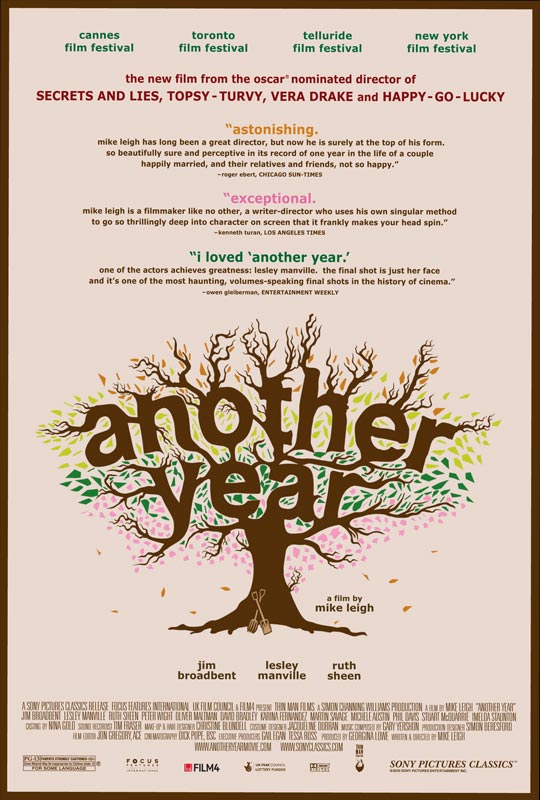
I generally avoid reading reviews until I’ve made my own conclusions. It’s a precaution against accidental plagiarism or having my opinion subtly altered. In the case of Another Year though, I felt safe. I was so convinced of my position, so sure of my assessment, I didn’t feel the usual need for prudence. I couldn’t imagine that the professionals would really have such a different viewpoint then my own. This assumption lead me to the Rotten Tomatoes rating of this film: 92%. It led me to rave reviews from Ebert and Travers and Scott. And more than anything, it entrenched my position that Mike Leigh‘s Another Year is one of the worst movies I’ve seen in a good long while. It is as smug and self-satisfied as its two chief characters, and leaves the viewer with nothing but questions. I don’t know what movie everybody else is watching, but Writer/Director Mike Leigh’s latest is a pretentious cipher of a film and, to put it plainly, not worth the film it was printed on.
Continue reading

Restrepo (2010)

60 Second Reviews

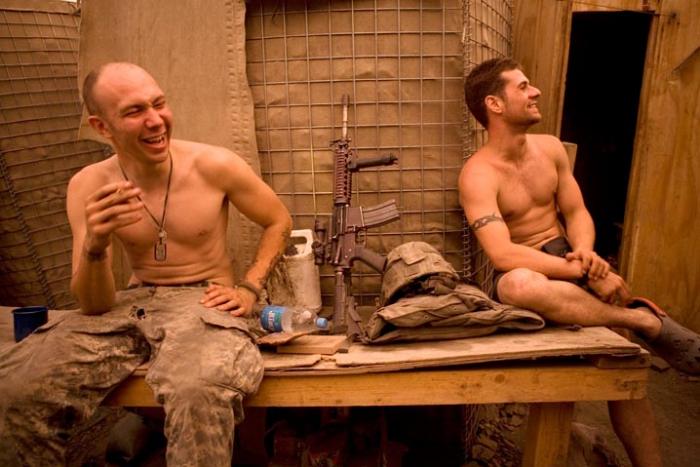
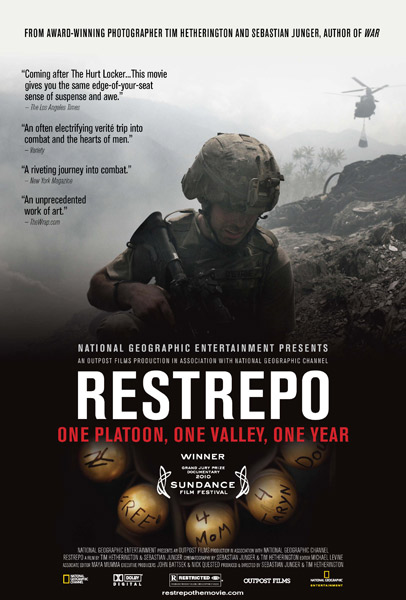
Restrepo-titled after the documentary’s pivotal outpost, which is named for PFC Juan Restrepo, a casualty of the war–tells the story of the armed forces men stationed in the Korangal Valley in Afghanistan and their agonizing day-to-day. The Korangal has been called the deadliest place on earth, and while filmmakers Tim Hetherington and Sebastian Junger don’t shy away from the awful reality, it’s the human side of a serviceman’s life that ends up being documented most effectively.

As documentaries go, Restrepo is unique, if not terribly complex. Unlike so many documentaries that tell a story by editing together footage and interviews for the most compelling result, here the chronology drives the story. Like any war hero recounting a tale, the story moves in a straight line, from beginning to end. Along with the directors’ hands-off approach to the editing of plot, they employ an interview style that allows the interviewees a remarkable amount of freedom. These men aren’t giving an account of events as much as they’re giving an account of their emotional and mental journeys. This flexibility of topic means the men spend as much time talking about each other and their lives back home as they do the war itself and life in the Korangal.

We’ve all heard stories of disturbed vets; men unable to extract themselves from war without massive mental trauma. These are those men. The soldiers from the Korangal have seen death in war, and have killed, and trying to return to a life that doesn’t account for these two extremes seems to be as draining as the war itself. What Restrepo does so well is let the men tell their own stories without interfering. While the film does take a stance, it doesn’t manufacture one, and perhaps that is more impressive then anything else about it.

A beautifully heartbreaking and wholly true story, Retrespo is shocking in both its content and its lack of manipulation.

Inception (2010)

Sometimes, in some ways, it feels as though Christopher Nolan might be tricking us. After Inception‘s release there were endless conversations and references made to the film’s strenuous complexity. People spoke of it as though it were as mysterious as Lost, when the reality is that it just sort of feels that way. Sure, Nolan is weaving a complicated fiction, but are there really that many stones left unturned? Are there really that many elements of this story left ambiguous? It seems much more the case that Nolan has simply done a masterful job of convincing us that if we want to appreciate this story, we had better stay on our toes. Meanwhile, as we kill ourselves trying to appreciate every last technical tidbit, we become immersed in this: an astonishing action movie with a broken heart.

Continue reading

Beauty and the Beast (1991)

60 Second Review

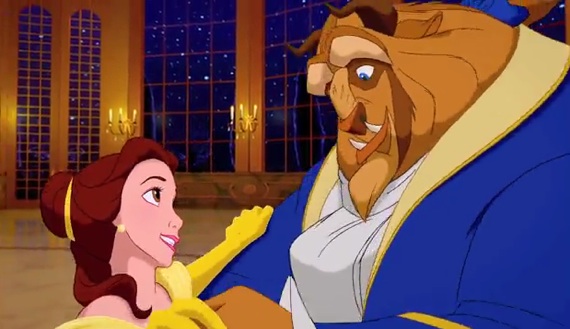
There are two kinds of movies. Movies that exist in the present, that you can consider and weigh and appraise impartially, and movies from your childhood; movies that have been a part of you since as far back as you can remember. Beauty and the Beast is squarely with the latter, insomuch as I don’t feel confident I can even have an objective response to it. This isn’t exclusively because I grew up with it, though that plays a huge role. Nearly as important is Disney’s masterful wielding of nostalgia. All of their films, even the ones you’re seeing for the first time, contain that magical schmaltz of childhood. Though every so often you get the feeling you’re being just a little bit manipulated, it’s easy enough to just go with it.

Beauty and the Beast really is a lovely little film, in spite of it’s tonally guiding hand. The music is as strong as any of Disney’s best films of that era, and the animation represents their highest tier work. Likewise the breakdown of characters is as solid a collection as any, with a hero and a villain and a beautiful princess who is, in fact, not a princess. If there’s a negative aspect to the film that has made itself more evident since childhood, it’s got to be the one-dimensionality of the characters. As with many Disney films, the secondary characters tend to have more personality then the primaries, and the starker the contrast between those two groups, the harder it is to ignore. Belle is boringly refined and and the Beast is more of an overgrown child then anything; certainly effective character types, but they don’t seem to grow in any other way than towards each other.

Nonetheless this is a fine entry into the Disney canon, and a more than vital contribution to their utter dominance of the nineties.

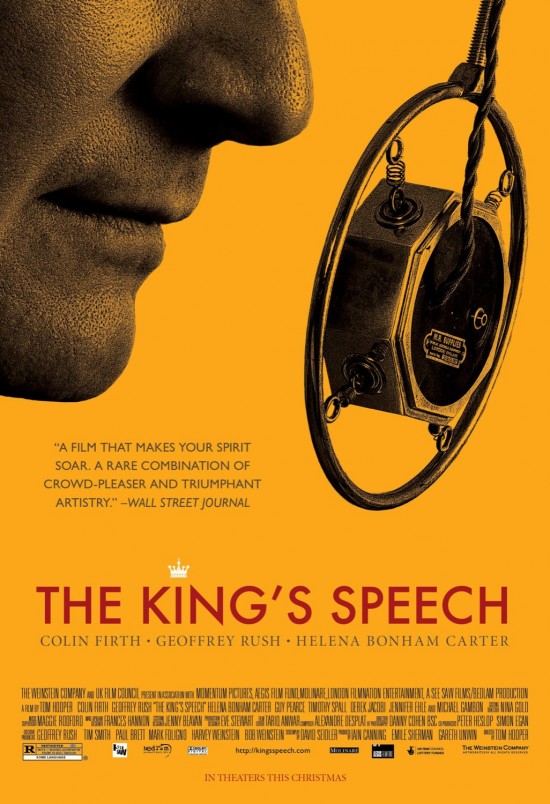
The King’s Speech (2010)


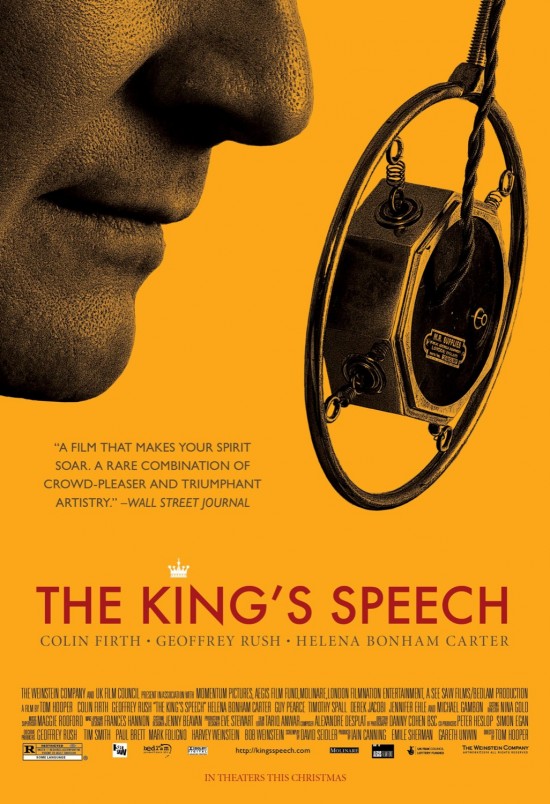
It seems that “Based on a True Story” is a qualifier used more and more these days.  This year alone contains the films 127 Hours, The Fighter, and The Social Network, which are all “based on…” to varying degrees.  It’s logical that dramatic reality is more compelling than dramatic fiction, and regardless of how truthfully one’s film follows that reality, people are going to respond to it.  The problem then comes when a filmmaker takes advantage of this fact and tells us a story that isn’t entirely worth telling, or a story more intriguing on paper than the screen.  It’s not black and white either, with films like The Social Network telling first-rate tales but taking huge liberties in order to do so.  Luckily, there are films like The King’s Speech, which don’t require any embroidery to astound us.  Films that have found the perfect historical confluence of event and characters and themes.  It’s the rarity of films like this that makes them so special, but in the case of The King’s Speech it’s also the quality of the yarn.  It is surely one of the best stories you’ve never heard.

Continue reading

The Fighter (2010)

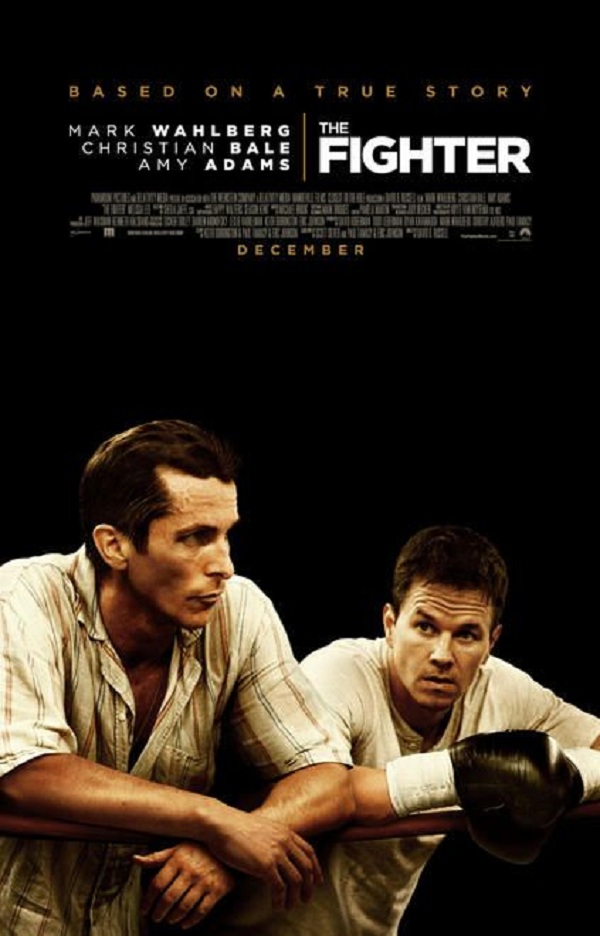
It seems that every year there’s a film like this.  A film that ends up feeling weighted more towards character portrayal than big picture.  A film with at least one performance almost guaranteed to bring home the Oscar.  Last year it was Jeff Bridges in Crazy Heart. Before that Heath Ledger in The Dark Knight. Before that Daniel Day-Lewis in There Will Be Blood.  The list goes on.  It’s not that David O. Russell‘s The Fighter is an incomplete film as much as it’s so entirely driven by its actors.  This based-on-a-true-story is clean and concise, and doesn’t require much sifting to get at a core comprised of an underdog vs. the world and the massive weight of his family.

Continue reading

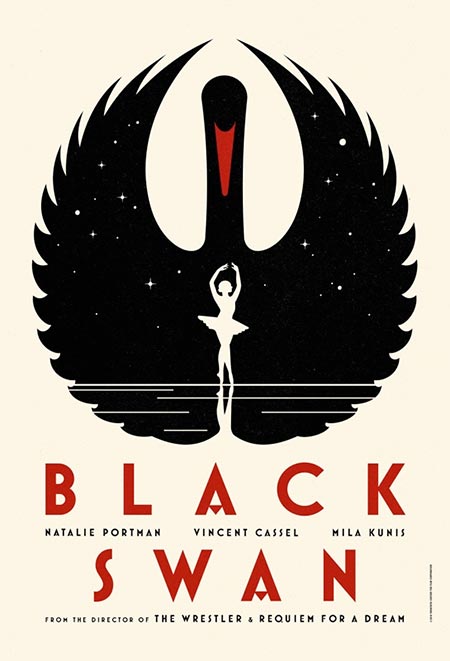
Black Swan (2010)

Preparing for a Darren Aronofsky feature is sort of like preparing for a break up or a funeral.  That’s not to say that every last Aronofsky tale is a saga of desolation or exhausting melancholy, but when you look at the man’s filmography, one of the common elements is a darkness that permeates.  The difference, though, between his earlier works (Pi, Requiem for a Dream) and his more recent (The Fountain, The Wrestler), is a respect for subtlety.  In Requiem, Aronofsky thrust the grotesque into the faces of his audience with an almost mean-spirited bravado.  It’s a film that, despite its high quality, is simply too awful for repeated viewings.  Lately though, Aronofsky has coupled that signature bleakness with a real human beauty.  He has found a balance in his method, and with his last three films, The Fountain, The Wrestler and now Black Swan, he has shown the kind of forward momentum that ensures real longevity.

Continue reading

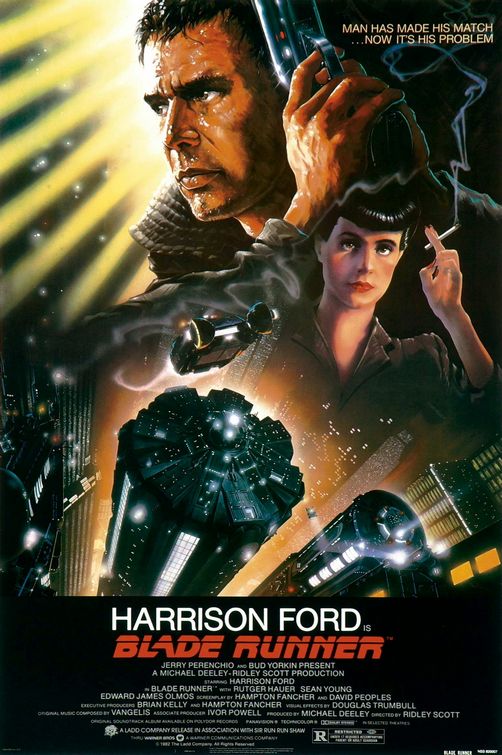
Blade Runner (1982)

What makes us human?” is one of those base existentialisms that we’re all a bit too cynical to actually consider.  It’s the type of query that for us to truly acknowledge the significance of, must be presented subtly and in the guise of “art.”  It is thusly that Ridley Scott‘s masterpiece Blade Runner is so successful in its theme.  Only once you have parted the curtains of a neo-noir and dystopic 2019 Los Angeles, only once you have passed through the door that is Scott’s and Douglas Trumbull’s remarkable achievement in visual effects, only once you’ve tiptoed past Vangelis’ eerily sinister neo-classical score do you arrive at the heart of this Philip K. Dick adaptation.  Blade Runner is precisely an interrogation of what it means to be human, or perhaps more specifically, what it means to question this humanity.

Continue reading

Toy Story (1995)

It’s ironic how entirely nostalgic it is viewing Toy Story for the first time in a decade.  Though I suppose that nostalgia shouldn’t surprise me, as nearly any Disney title awakens vivid memories of childhood and the wonder of animated cinema.  Obviously the world of Disney pre-Pixar is iconic, particularly for those of us lucky enough to grow up during their late 80s/early 90s renaissance.  My particular favorite was Aladdin, but I’ve never been picky, and would gladly sit through a viewing of The Little Mermaid or Beauty and the Beast. Heck, I’d even watch Pocahontas. Still, while Disney’s astounding talent for inserting themselves into childhood is something I’m grateful for, it’s only part of what makes my adult viewing of Toy Story ironic.  The more relevant aspect of that irony is the reality that Toy Story is a movie about nostalgia.  Or at the very least it’s a movie that recognizes the heft of it.  Memories of childhood are either beautiful or awful, and rarely of the mundane; what trauma or drama is there in the tedium of childhood?  Though we catch only glimpses of the story from adolescent Andy’s perspective, the one requirement for enjoying this film is to have been that age, and to have loved those toys.  Perhaps one of Disney’s, Pixar’s and director John Lasseter‘s most charming notions is imagining that those toys could love you back.

Continue reading

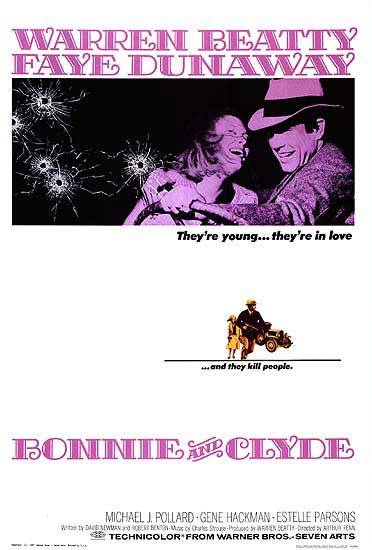
Bonnie and Clyde (1967)

The American Film Institute lists Bonnie and Clyde at number 5 on their list of the top ten gangster films of all time, and 42 on their “100 Years…100 Movies” collection.  IMDb holds it at 218 on their top five hundred.  For the older film generation this will come as no surprise.  Bonnie and Clyde‘s release was loud and unforgettable, and represented a jump to the “New Hollywood.”  Violence and sex were no longer suggestions, and the previously established style of filmmaking was beginning to unravel.  In hindsight the film still distinguishes itself from it’s peers, along with The Graduate, a fellow Best Picture nominee from that year.  But the unfortunate truth of Bonnie and Clyde‘s place in modern day cinema is it’s senescence.  The film simply hasn’t aged well.  It’s legacy lives in it’s forward momentum, and less and less in it’s quality.  It glimpses at things to come, but is by no means an example of transitional perfection.  A brave film that comes from a time where progress was as significant as caliber.

Continue reading