
Tag Archives: Opinion

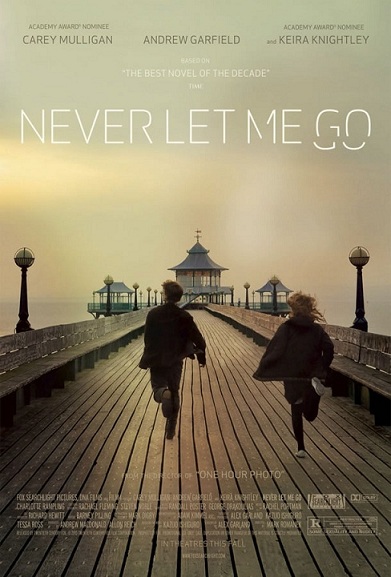
Never Let Me Go (2010)

I’m overwhelmed.  After a summer of crude, overly-budgeted nonsense, the last three weeks have found me in the theater watching films that were thoughtful, mature, and perhaps most resonantly, emotionally razing.  I’ll say again: I’m overwhelmed.  It’s exciting to arrive at this time of year as the mood starts to shift along with the caliber, but it’s also important to be prepared for it, and I can’t say that I have been.  I’ve gone head first into these films with little more than excitement to safeguard me.  Today, this trilogy of despair came to its logical conclusion with the lovingly crafted and deeply heartbreaking Never Let Me Go.

Continue reading

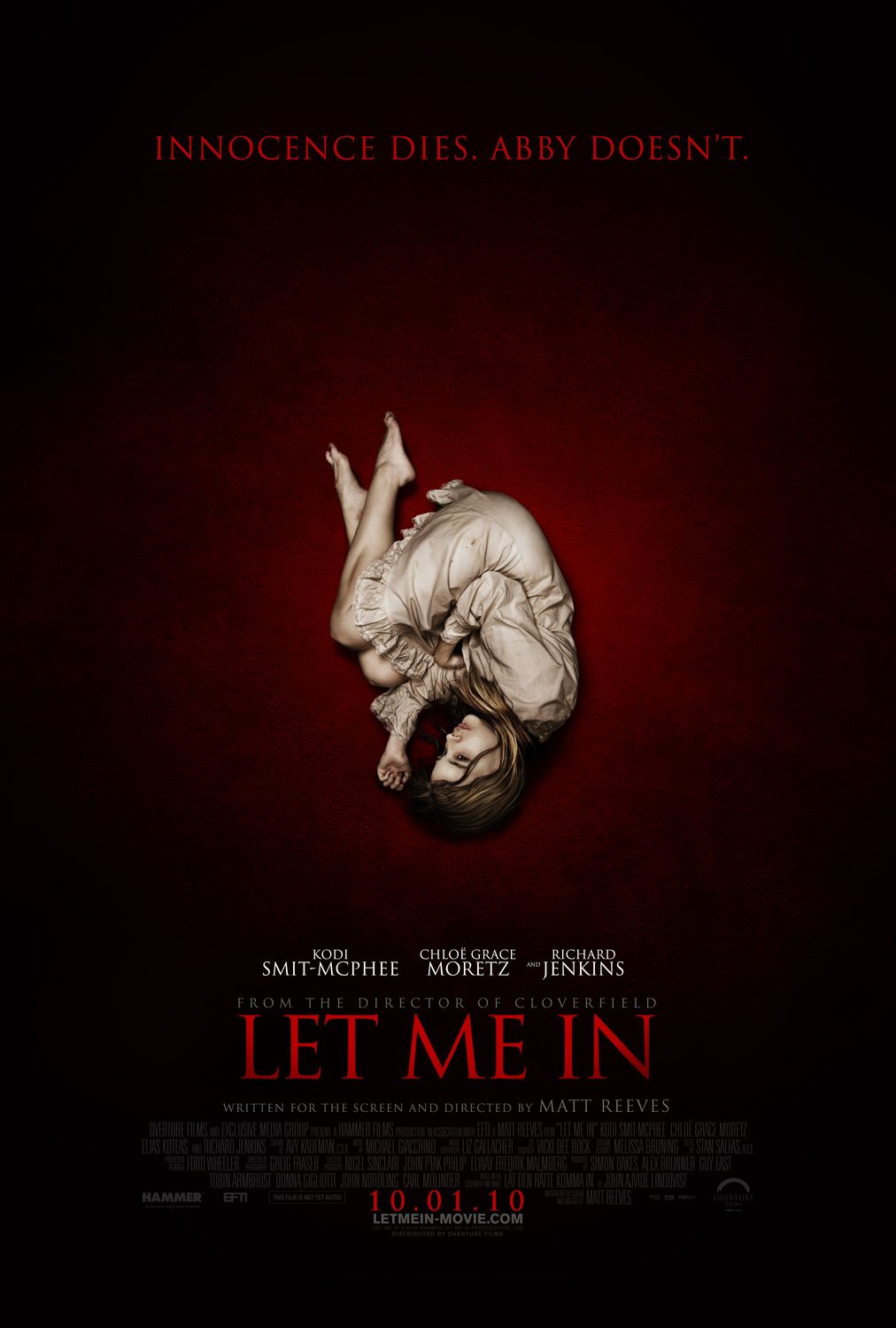
Let Me In (2010)

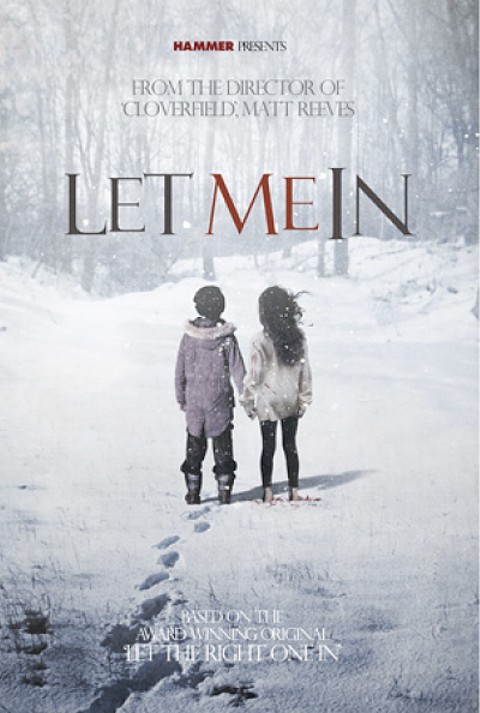
Let’s get it out of the way.  An American remake of 2008’s internationally successful Swedish film Let the Right One In was a bizarre choice and blatantly shallow.  I suppose one could say that the motivation for an Americanized version is based on the quantity of character and story, and not just that the film is marketable and vampires are hot right now.  Nonetheless, in the words of the original’s own director, “If one should remake a film, it’s because the original is bad, and I don’t think mine is.”  So then, a viewing of Matthew Reeves‘ less than scrupulous Let Me In can either be dismissed from square one, or it can be viewed and judged despite its bastardization.  Thankfully, I chose to do the latter.

Continue reading

Buried (2010)

What is it about claustrophobia that people find so terrifying?  Often it seems tied inherently to death, but in every case the two certainly aren’t connected, yet claustrophobia remains for many a nightmarish prospect.  The physical constriction.  The loss of the air.  The darkness.  It’s an entirely sensory experience and perhaps this is why it’s nearly impossible to rationalize.  And perhaps this is why up-and-comer Rodrigo CortésBuried is so intensely effecting.  While there may be time to think about what’s happening, there’s not all that much to think about, which means the viewer expends far more energy simply experiencing the film.  Bearing in mind the simplicity of this concept, the utter spareness of the production, and the reliance on the singular performance of Ryan Reynolds, Buried truly is something to see.  Or, more to the point, something to feel.

Continue reading

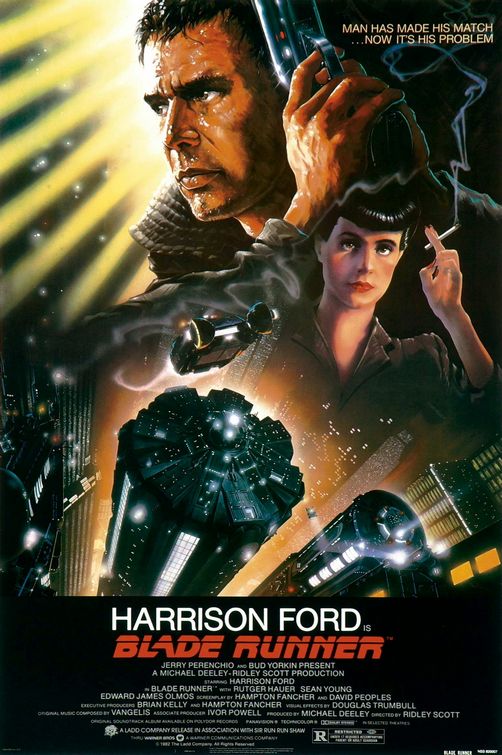
Blade Runner (1982)

What makes us human?” is one of those base existentialisms that we’re all a bit too cynical to actually consider.  It’s the type of query that for us to truly acknowledge the significance of, must be presented subtly and in the guise of “art.”  It is thusly that Ridley Scott‘s masterpiece Blade Runner is so successful in its theme.  Only once you have parted the curtains of a neo-noir and dystopic 2019 Los Angeles, only once you have passed through the door that is Scott’s and Douglas Trumbull’s remarkable achievement in visual effects, only once you’ve tiptoed past Vangelis’ eerily sinister neo-classical score do you arrive at the heart of this Philip K. Dick adaptation.  Blade Runner is precisely an interrogation of what it means to be human, or perhaps more specifically, what it means to question this humanity.

Continue reading

The American (2010)

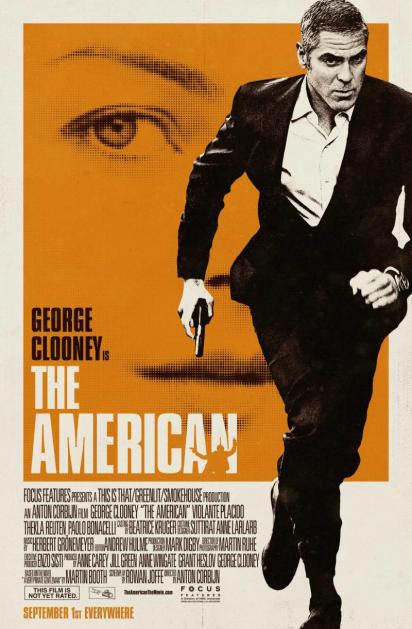
There’s something poetic about The American opening next to Machete, Robert Rodriguez’s latest explosion of cheeky violence.  And Machete is certainly not the only case of superfluous violence in recent memory.  The Expendables, Piranha 3D, The A-Team, even Kick-Ass way back in April.  Film this summer hasn’t had much interest in subtlety or consequences.  Meanwhile Anton Corbijn‘s The American is quietly released, it’s trailer ambiguous and cerebral, it’s only apparent draw for the average movie-goer a shirtless George Clooney.  After an assault of films who hope to stay unrelentingly in your face for a full two hours, The American gently hopes only to do the next best thing: stay in your mind.

Continue reading

Piranha 3D (2010)

3D film is a gimmick.  It doesn’t contribute in any regard other than the visual experience, and despite all the current hype, it’s a one-trick pony that seems to have been mostly explored.  That’s not to say everything has been done, but ultimately the 3D experience has only so much to offer.  With this in mind I was actually excited by the prospect of Piranha 3D. If 3D film is a purely visual device with essentially zero regard for story, then it stands to reason that the perfect platform for this technology is a film like Piranha; an over-the-top celebration of boobs and blood.  Much like pornography the film is quite apparently unconcerned with story, doing just enough to get you to the next massacre.  I was eager to see how this would play out and came into the film with high hopes.  Much like the endless hotties dancing on boats, those hopes got really drunk, took off their tops and were promptly eaten alive.

Continue reading

Toy Story (1995)

It’s ironic how entirely nostalgic it is viewing Toy Story for the first time in a decade.  Though I suppose that nostalgia shouldn’t surprise me, as nearly any Disney title awakens vivid memories of childhood and the wonder of animated cinema.  Obviously the world of Disney pre-Pixar is iconic, particularly for those of us lucky enough to grow up during their late 80s/early 90s renaissance.  My particular favorite was Aladdin, but I’ve never been picky, and would gladly sit through a viewing of The Little Mermaid or Beauty and the Beast. Heck, I’d even watch Pocahontas. Still, while Disney’s astounding talent for inserting themselves into childhood is something I’m grateful for, it’s only part of what makes my adult viewing of Toy Story ironic.  The more relevant aspect of that irony is the reality that Toy Story is a movie about nostalgia.  Or at the very least it’s a movie that recognizes the heft of it.  Memories of childhood are either beautiful or awful, and rarely of the mundane; what trauma or drama is there in the tedium of childhood?  Though we catch only glimpses of the story from adolescent Andy’s perspective, the one requirement for enjoying this film is to have been that age, and to have loved those toys.  Perhaps one of Disney’s, Pixar’s and director John Lasseter‘s most charming notions is imagining that those toys could love you back.

Continue reading

Eat Pray Love (2010)

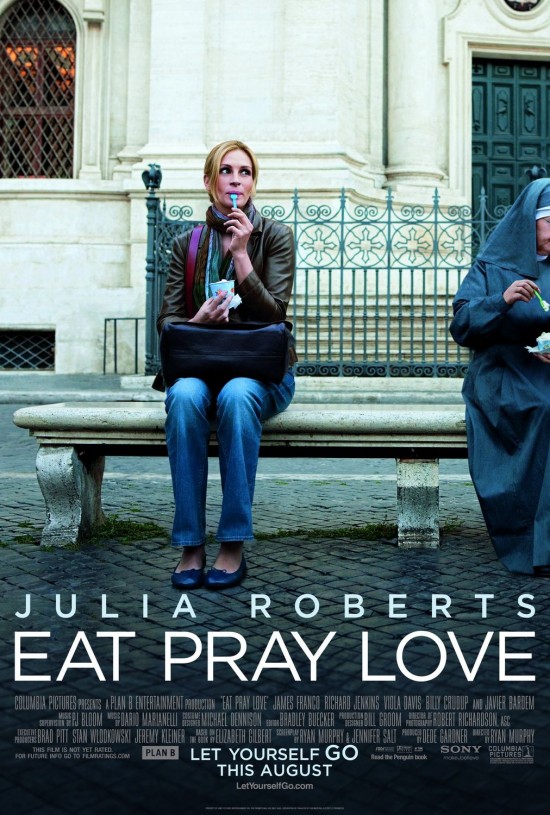
I never read Eat Pray Love.  It never seemed like a book written for me.  Vaguely, my understanding of the novel was as one written by a woman and for women.  A self-help memoir for the divorced.  Now that I’ve seen the book’s celluloid abridgement my notions have been, to an extent altered.  Not entirely, for this is still a story about mending a broken heart and Elizabeth Gilbert (Julia Roberts) surely begins that process with the old standby of eating mass quantities of food.  But to say my vague awareness of this incredibly popular book was on point would discount the deeper ideas present in this story.  Gilbert (with help from director and screenwriter Ryan Murphy) isn’t just moaning about her losses.  She’s giving an account of an adventure she had; a journey to the center of her soul.  It’s not perfect, with moments of cloying joy that don’t feel real enough, but it’s all true, and it represents a search as eternal as any.  Whether recently divorced or recently preadolescent, we are all of us looking for our place in the world, and we are all of us praying that it will bring with it some love.

Continue reading

The A-Team (2010)

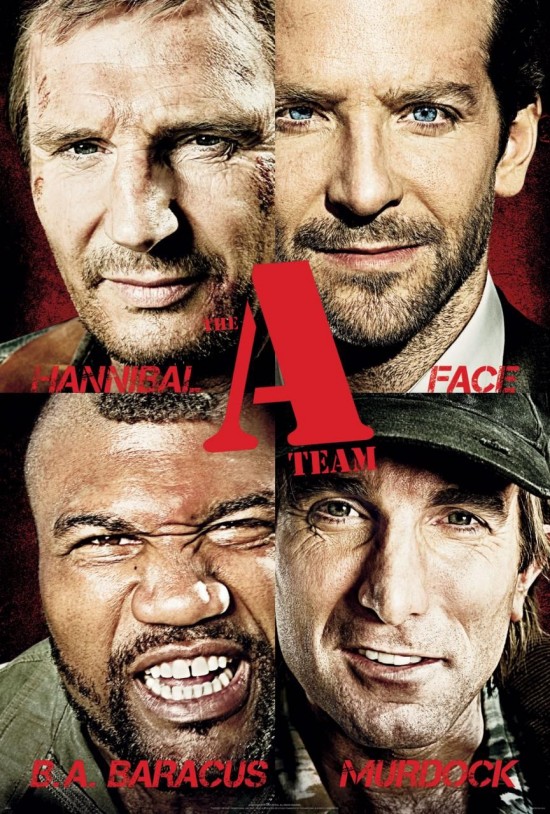
I never watched the show.  Mr. T was the only aspect that seemed at all intriguing, and he just wasn’t enough to pull me.  And the chafing part of watching The A-Team in theaters is how much of a problem that became.  Without an understanding, without an awareness of the minor characters and the relationships and the dated sense of humor, this film becomes work.  There’s an ever-present potential for reference, which means the under prepared viewer is never able to settle down and simply have an experience.  An experience which, besides it’s desperate obligation to the source, is mostly scrambled and frenetic.  Like most of the summer movies you’ve ever seen, the first priority of The A-Team is to bombard you with action.  I’m not sure what it is about these productions that precludes the possibility of spectacular action AND an enjoyable story.  Certainly it’s not as though we’ve never seen it before (A couple Mission Impossible movies, a few James Bond‘s, the Bourne flicks, etc.), but whatever the logic, The A-Team is definitively just one piece of the pie, ghosting everything else and smirking, as it inevitably and perhaps appropriately, makes stupid amounts of money.

Continue reading

Splice (2010)

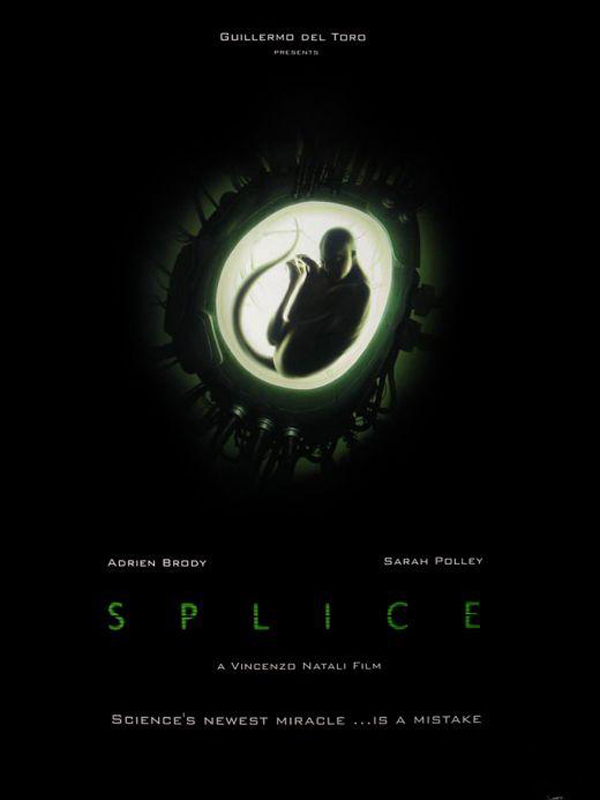
Mostly I felt uncomfortable during Splice. I wrung my hands a lot and rubbed my eyes; the kind of anxious fiddling that should spell trouble for a film.  The thing is though, I’m not sure how much of my discomfort was intended by the filmmakers, and how much was just a product of poor decision making.  On one hand, Splice is intentionally brimming with disconcerting genetic science, it’s hazy morality and ghastly creatures tantalizing.  On the other, it’s lousy with unlikeable characters, maddening choices and awkward exchanges.  Trying to gauge what’s intended and what isn’t can be taxing to say the least, which shouldn’t necessarily guide judgment.   But it does, and that inconsistency, coupled with the assumption that I probably wouldn’t like the filmmakers all that much, means an unstable experience that’s more down then up.

Continue reading