
Category Archives: Oscar Winner

The Fighter (2010)

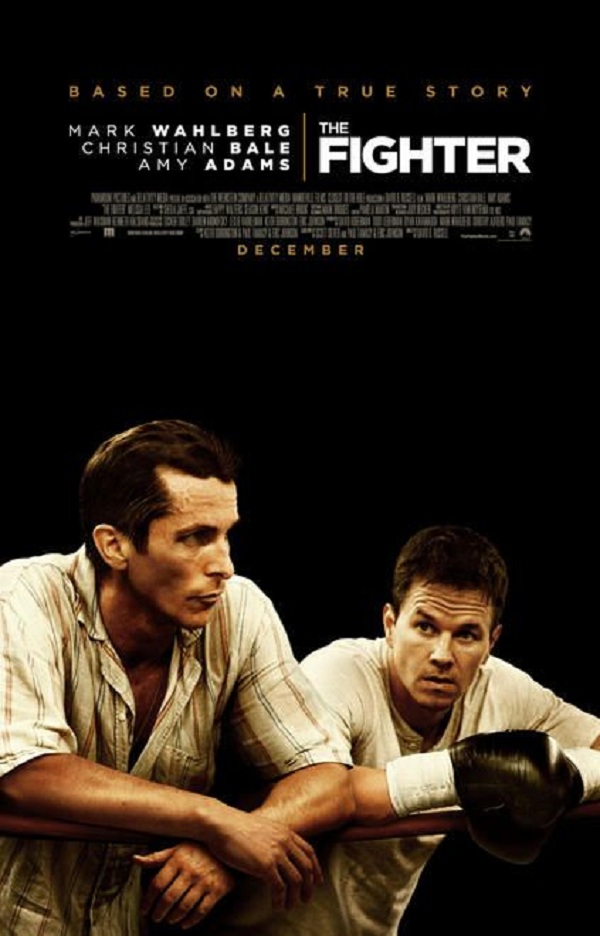
It seems that every year there’s a film like this.  A film that ends up feeling weighted more towards character portrayal than big picture.  A film with at least one performance almost guaranteed to bring home the Oscar.  Last year it was Jeff Bridges in Crazy Heart. Before that Heath Ledger in The Dark Knight. Before that Daniel Day-Lewis in There Will Be Blood.  The list goes on.  It’s not that David O. Russell‘s The Fighter is an incomplete film as much as it’s so entirely driven by its actors.  This based-on-a-true-story is clean and concise, and doesn’t require much sifting to get at a core comprised of an underdog vs. the world and the massive weight of his family.
Continue reading

Black Swan (2010)

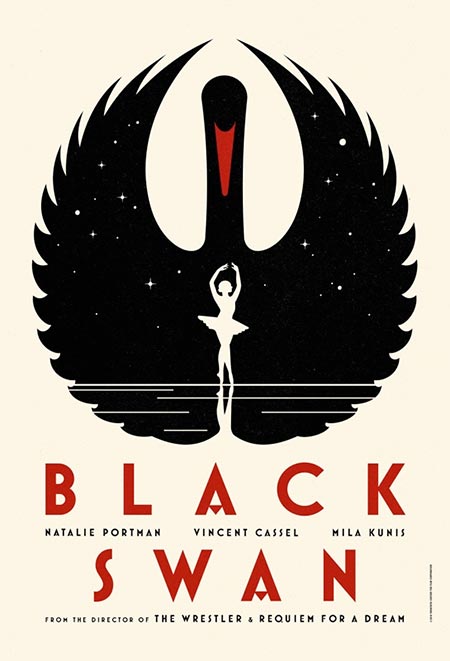
Preparing for a Darren Aronofsky feature is sort of like preparing for a break up or a funeral.  That’s not to say that every last Aronofsky tale is a saga of desolation or exhausting melancholy, but when you look at the man’s filmography, one of the common elements is a darkness that permeates.  The difference, though, between his earlier works (Pi, Requiem for a Dream) and his more recent (The Fountain, The Wrestler), is a respect for subtlety.  In Requiem, Aronofsky thrust the grotesque into the faces of his audience with an almost mean-spirited bravado.  It’s a film that, despite its high quality, is simply too awful for repeated viewings.  Lately though, Aronofsky has coupled that signature bleakness with a real human beauty.  He has found a balance in his method, and with his last three films, The Fountain, The Wrestler and now Black Swan, he has shown the kind of forward momentum that ensures real longevity.

Continue reading

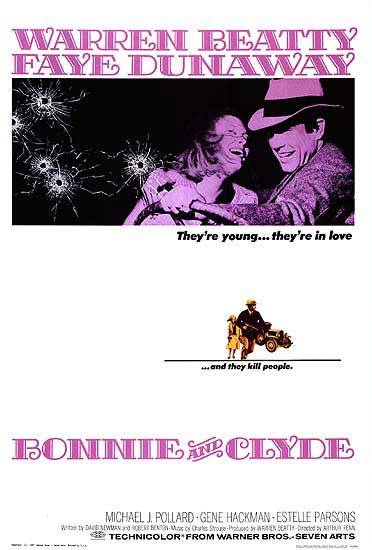
Bonnie and Clyde (1967)

The American Film Institute lists Bonnie and Clyde at number 5 on their list of the top ten gangster films of all time, and 42 on their “100 Years…100 Movies” collection.  IMDb holds it at 218 on their top five hundred.  For the older film generation this will come as no surprise.  Bonnie and Clyde‘s release was loud and unforgettable, and represented a jump to the “New Hollywood.”  Violence and sex were no longer suggestions, and the previously established style of filmmaking was beginning to unravel.  In hindsight the film still distinguishes itself from it’s peers, along with The Graduate, a fellow Best Picture nominee from that year.  But the unfortunate truth of Bonnie and Clyde‘s place in modern day cinema is it’s senescence.  The film simply hasn’t aged well.  It’s legacy lives in it’s forward momentum, and less and less in it’s quality.  It glimpses at things to come, but is by no means an example of transitional perfection.  A brave film that comes from a time where progress was as significant as caliber.

Continue reading

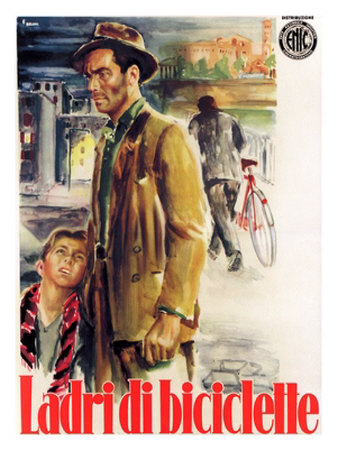
Bicycle Thieves (1948)

Desperation.  A theme found in an endless collection of stories and one that never lessens in it’s ability to impact us.  The power of this theme comes from the consequences of desperation, specifically the dramatic loss of honor that seems so inevitably tied to it.  It’s this universal emotion that allows Vittorio De Sica‘s Bicycle Thieves to remain so consistently effecting.  The story is simple, and not at all burdened with multiple dilemmas.  Just one: survive.  Survive for family, survive for honor, just survive.  Because this, more than anything else, is the point of existence.

Continue reading

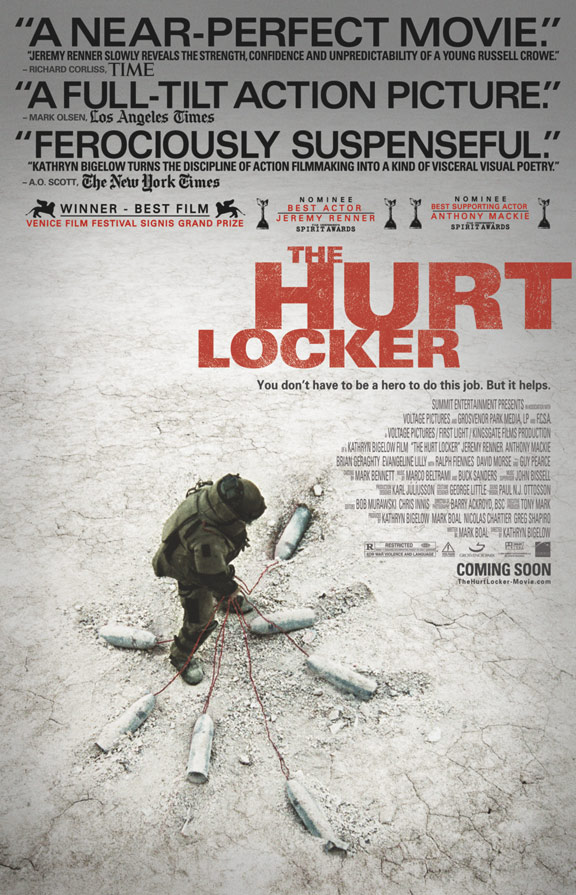
The Hurt Locker (2009)

With The Hurt Locker, I ended up watching a very different film than I intended to.  The plan was to sit down and enjoy a dramatic war movie with nuanced performance and subtlety; an Oscar contender.  By the end though, I was watching a high suspense thriller that happens to take place in Iraq.  It’s not an insignificant difference, and it was one I needed to make before I could fully appreciate what I was watching.  Expectation is often the bane of a viewer’s existence, and that’s never more true than when one finally watches an Academy nominee.  The film was released on June 26th and Oscar-buzz began shortly thereafter.  Ever since then, our unformed opinions have been molded by everything BUT the movie itself.  I hate this for a number of reasons, but mostly because it’s unavoidable.  Either see it opening day, or go live in a cave.  Otherwise you had better be prepared to do battle with the forces of subjective opinion, because brother, they’re a-comin.

Continue reading

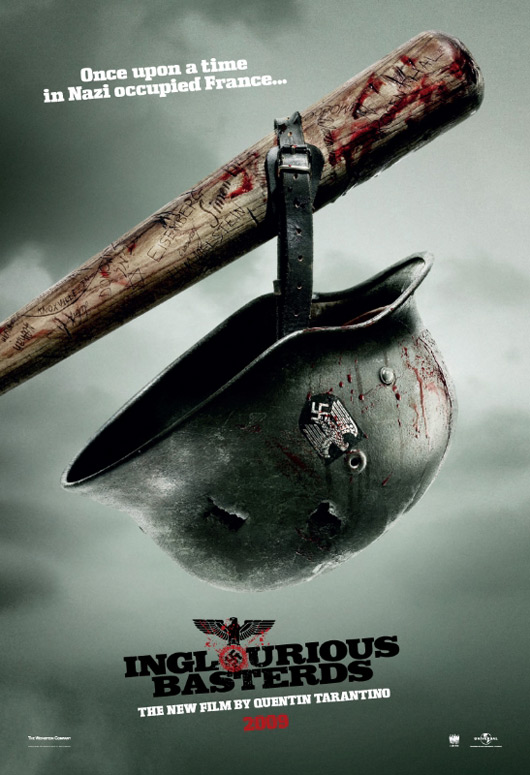
Inglourious Basterds (2009)

The third act of Quentin Tarantino‘s Inglourious Basterds finds the Nazi elite mingling languidly in a quaint and gorgeous theater in Paris.  They are here to witness the debut of Joseph Goebbel’s latest film, Nation’s Pride, an account of Private Frederick Zoller’s (Daniel Brühl) war heroics, wherein he killed hundreds of Americans with only a gun and his German cunning.  From Bormann, to Goebbels, to Hitler himself, the Third Reich’s most distinguished members are in attendance to celebrate a mass slaughter carried out by one of their own.  And he no more than a private in Hitler’s army.  Zoller’s exploits feed their nationalism, their lust for victory, and as the lights in the theater dim and the film rolls, Goebbel’s film finds a ruggedly handsome Frederick Zoller killing one American after the next for an eternity.  The audience is held captive in their delight, their sweaty, angry faces beaming with a rapture both large and terrifying.  For you see, according to Quentin, Nazis are simply irritable nerds, and death is their porn.

Continue reading

8½ (1963)

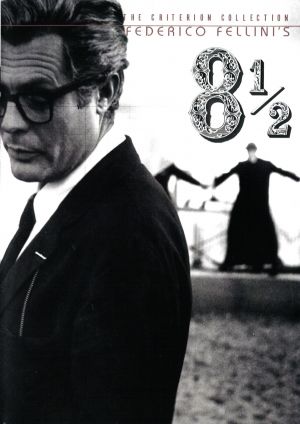
The characters of Federico Fellini‘s are obsessed with age.  Apart from the occasional young person who somehow finds their way into a scene and is simply too naive to know any better, or to care, the chief characters range in age from their late 30s to nearly bedridden and all of them are desperate to regain that which is lost.  The men all have mistresses far younger than they, the women make themselves up literally and with feigned indifference.  While this is not the point of , it is significant to it.  This film is about the fear of commitment, both artistic and emotional.  Allowing age to run rampant in the way it does here, with barrages of the elderly ambling about in the sunlight (in a place so strongly resembling the afterlife it’s no wonder nothing gets done) and women whose usefulness runs out around the age of 55, suggests to the audience that time is fleeting and commitment is an anchor.  Freedom to pursue whatever you want comes at the cost of not being tied down.  To what?  Your producer, your crew, your cast, your friends, your wife, your mistress, your ideas, your ideals, yourself.

Continue reading

Crazy Heart (2009)

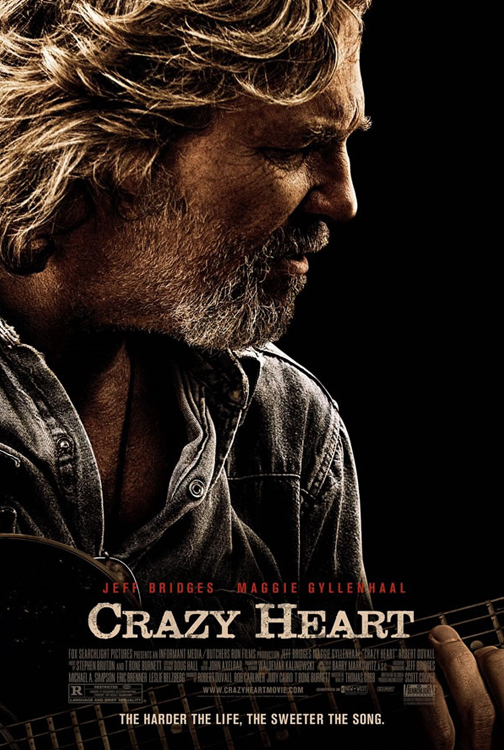
As much as Country Western music is derided, there’s something romantic about its weathered subject matter.  An ambling loner in a bar, a whiskey and a beer, a battered jukebox.  It’s cliche, but it’s also purely American, and this is I think is what allows it to transcend a genre so many people love to hate.  This archetype forms the basis of Crazy Heart, written and directed by Scott Cooper in his debut behind the camera.  Following that lone figure through the travails of his older years, the film surveys the modern American West lifestyle as well as the broader themes of a washed-up musician, tiredly yearning for his glory days.

Continue reading

Up (2009)

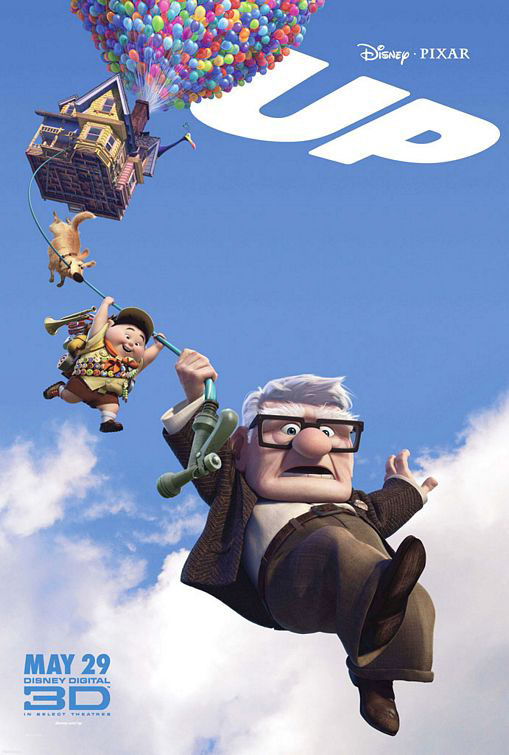
There are elements of story, structure and general film making concepts that are universally heralded or criticized.  Conflict is good, artificial dialogue is bad.  Character development is good, cliche is bad.  And so it goes.  But there are also enumerable aspects of a film which can’t truly be judged in the same way.  Special effects come to mind as something that can at once be either terribly off-putting or the outstanding piece of the puzzle.  Similarly, an adaptation can fill seats or turn viewers off based solely on it’s faithfulness to the original material.  With Up, this dilemma presents itself in the form of sentimentality.  There’s no lack of emotional resonance here, no shortage of moments that bring a visceral response…that is, if you’re into that sort of thing. Continue reading

Avatar (2009)

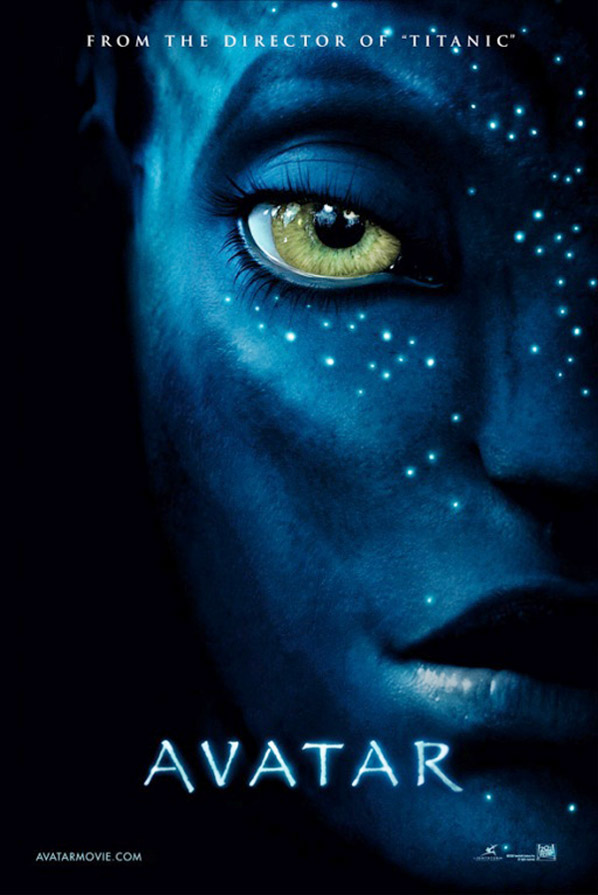
A glance at James Cameron‘s filmography reveals a Director mildly obsessed with doing things on an epic scale.  The only names that come to mind who might epic him out of the top spot would be Bay and Bruckheimer, and those guys don’t generally hold a lot of water with critical minds.  Cameron however seems to ride that line between over the top and elegant.  The distinction most probably lies with Cameron’s credits as a Director and a Writer.  While technology and visual magnificence hold his regard, I don’t believe they do so exclusively.  Particularly with his last few films, James Cameron has shone an eye for story that allows him to do the remarkable things he can do visually while not bombarding his audience with absurd or scoff-worthy moments.  This is not to say that Cameron isn’t melodramatic, but coupling melodrama with compelling characters, complex situations and, again, astonishing visual effects, might just be the perfect recipe for the epic of the new millennium.

Continue reading